Office Clearance in Edmonton

Our office clearance in Edmonton service is built for businesses that need a practical, orderly way to clear redundant furniture, fixtures, paperwork, and mixed office contents from workspaces, storage rooms, and shared areas. We handle clearances with an emphasis on sensible sorting, careful loading, and a tidy finish, so the space can be handed back, refurbished, or repurposed with less disruption than an unmanaged move-out. If you need a straightforward way to deal with an office that has reached the end of its current use, our service gives you a clear starting point.
We work across the kinds of items commonly found in offices: desks, chairs, cabinets, shelving, filing units, screens, reception furnishings, and non-sensitive general waste. Where a clearance includes mixed material, we separate suitable items for reuse, recycling, and disposal in line with the nature of the load. Clear planning matters because office spaces often contain a blend of reusable fixtures and items that need careful handling, so the aim is to remove what is no longer needed without creating extra confusion.
To request a quotation, it helps to outline the size of the premises, the main items involved, and any access points or timing considerations that might affect the work. If you already know that the clearance includes heavy furniture, archive material, or awkward items that need disassembly, mention that early so the scope can be assessed properly. You can also use our plain-English pricing information before you decide how to proceed: pricing and quotes.
What our office clearance service covers
Office clearance usually involves more than simply removing a few unwanted pieces. A proper clearance may include individual workstations, meeting room furniture, storage furniture, redundant reception items, loose office equipment, packaging, and general non-hazardous contents left behind after refurbishment or relocation. Our approach is designed to clear the space methodically, with attention to access, item handling, and the order in which different materials are removed, so the process stays manageable from start to finish.
We can also support clearances where the layout has changed over time and the contents are no longer arranged in a simple way. That might mean taking apart modular furniture, moving items from multiple rooms, or dealing with stored materials that have been left in cupboards and back offices. For a broader view of the type of work we handle, see office clearance and business waste removal, which sit alongside this service when organisations need a fuller clear-out.
In practical terms, a good clearance is about ensuring the remaining area is left ready for its next stage. That may be a handover, an internal reorganisation, a fit-out, or a simple return to a usable condition. The clearer the scope, the easier it is to match the work to the right resources. Careful separation of item types also matters, especially where recyclable materials or reusable furniture are part of the load.
Furniture and fittings from workspaces

Many office clearances are dominated by furniture rather than loose waste, so it is important to treat items in a way that suits their construction. Desks, meeting tables, filing units, bookcases, storage cupboards, and pedestal drawers often need to be moved through narrow corridors or down stairwells, and some items may need to be dismantled before removal. Our service is intended to make that process more orderly, rather than leaving the customer to manage heavy or awkward pieces without support.
Where furniture is still in usable condition, it may be suitable for reuse or passing on through an appropriate route. Where items are damaged, worn out, or structurally unsuitable, they can be separated for recycling or disposal according to what they are made from. The same principle applies to reception furnishings and fitted office pieces that have become redundant after a redesign. If you also have domestic-style items mixed into the office space, our furniture clearance and furniture disposal pages explain those related options.
It is often helpful to think in terms of what stays, what moves, and what leaves. That simple split keeps the work focused and prevents avoidable damage to items that are meant to remain on site. Good organisation also helps where items are stored in different rooms or floors, because the removal sequence can then follow a sensible route through the building instead of disturbing occupied areas unnecessarily.
Clearances for redundant equipment and stored contents
Office spaces commonly include mixed contents that are easy to overlook until the end of a tenancy or refurbishment. This can include shelving units, boxed supplies, archived paperwork, display materials, old monitors, stands, and general stored items that no longer serve a purpose. A clear-out is more effective when those contents are assessed alongside the larger furniture pieces, because it avoids leaving small but time-consuming materials behind.
Where the clearance extends into storage rooms, cupboards, or back-office areas, we can handle the removal in a structured way so those spaces are emptied as well as the main work areas. This is often useful when a business wants to return a room to full use or prepare a building for the next phase of work. Related services such as home clearance and house clearance show the same method applied to other property types, though an office typically brings its own mix of fittings and operational items.
Not every office clearance looks the same, and that is one reason why an accurate description of the contents is so valuable. A small suite with a few desks can be handled very differently from a multi-room office with archive storage and older furniture that has accumulated over time. The more clearly the load is understood, the easier it is to organise the work in a way that respects both the contents and the building.
How an office clearance is usually organised
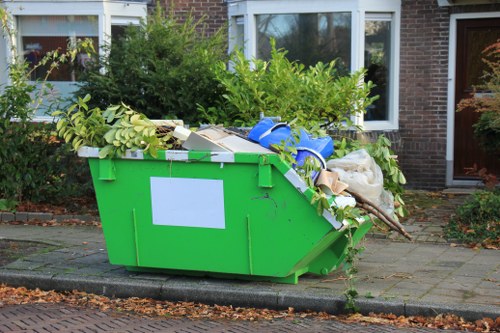
Most commercial clearances work best when they are approached in stages. First comes the review of what is present, then the sorting of items by type, and then the physical removal in a sequence that suits the premises. A sensible sequence helps reduce bottlenecks, especially in shared buildings or offices with limited access, where it may be better to clear one area before moving to the next. The end goal is not just removal, but a usable and tidy result.
For many customers, the most useful information to provide at enquiry stage is straightforward and factual. A simple outline of floor level, lift access, parking or loading constraints, item volumes, and any particularly heavy or awkward pieces will usually give a clearer basis for quotation. If archives, electronics, or furniture require separate treatment, mention that too, because mixed loads are easier to price and plan when the main components are known in advance. For related internal guidance, about us can be useful if you want a broader view of the business, while contact us is the natural route when you are ready to ask for a quotation.
Our aim is to keep the process understandable rather than complicated. If there are rooms that need to be cleared in a particular order, or items that must be left in place until the final stage, those requirements can be factored into the plan. A well-managed office clearance should feel organised and predictable, with the work carried out in a way that fits the layout and the deadline.
Office moves, refurbishments and end-of-lease clear-outs
Office clearance is often required at points of change: the end of a tenancy, a relocation, a fit-out, or a refurbishment. At those moments, the contents of the premises need to be reduced quickly and sensibly so that other trades or building work can take place. Our clearance service is suited to those situations because it focuses on removing redundant items and leaving the remaining space easier to manage.
Where a landlord, managing agent, or business owner needs an area returned in a certain condition, a structured removal process is usually more effective than trying to deal with the contents piecemeal. The work may involve several rooms, shared corridors, or ancillary areas such as storage cupboards and staff kitchens. The important point is that the clearance matches the real layout of the premises, rather than assuming that all office jobs are the same. flat clearance and garage clearance are different services, but they show how the same careful approach can be adapted to a different setting.
For businesses, one of the main benefits of a focused clearance is that it helps reduce the amount of loose material left behind once furniture has gone. That can make the later stages of the move or refurbishment simpler, because there is less clutter to sort through at the last minute. If a clear-out has several phases, the first can be arranged to remove the obvious surplus and the later stage can deal with items that remain in harder-to-reach spaces.
Materials, recycling and disposal choices

Different office contents need different handling, and that is why it is useful to look beyond the headline description of “office wasteâ€. Wood-based furniture, metal shelving, mixed-material chairs, packaging, paper, and certain electrical items may each require a separate decision about the right route onward. A careful clearance seeks to sort those streams rather than pushing everything into one category, because that supports better handling of the material and a neater result on site.
Recycling and responsible disposal are part of the service conversation, especially when offices contain a significant amount of furniture or equipment that can no longer be used. While not every item will be suitable for reuse, many clearances benefit from separating recoverable materials from general waste. You can read more about our wider approach through recycling and sustainability and, where safety considerations matter, insurance and safety.
It is also worth remembering that office spaces sometimes contain items that are not part of the main clearance but still need to be identified before work begins. Those may include blinds, noticeboards, loose storage crates, or small fixtures that are attached to walls or furniture. A clear scope prevents confusion on the day and helps keep the clearance moving in a tidy, logical order.
Practical details that help with quotation
A quotation is easier to prepare when the main facts are clear. The most useful details are the size of the office area, the kinds of furniture involved, how much material needs removing, and whether the work is spread across one floor or several. If there are any access limits, such as narrow stairways, controlled entry, or restricted parking, that should be included as well. These are ordinary planning points rather than complications, but they make a real difference to how the work is arranged.
One simple way to prepare is to make a short list of the key areas and item groups.
- Main rooms to be cleared
- Large furniture or fixed items
- Stored materials, files, or mixed contents
- Access notes and timing preferences
There is no need to overcomplicate the first step. A concise description of what needs removing, along with any items that should stay where they are, is usually enough to start the conversation. If the clearance is part of a broader office project, it can also help to note whether the work must be completed before decorators, builders, or fit-out contractors arrive.
About Edmonton
Edmonton is an area in north London, within the London Borough of Enfield, and its character has been shaped by long-term growth from village and market-town roots into a densely settled urban district. The area is closely associated with the historic North Circular corridor, the River Lea valley, and a mix of residential streets, local shopping parades, and larger roads that connect it with neighbouring parts of north London. Edmonton Green is one of its best-known centres, combining retail space, transport links, and public realm that gives the district a clear focal point. The name Edmonton also carries literary and historical associations, including links to the old parish landscape of Middlesex before modern administrative changes transformed the local framework. The area contains varied building types, from older terraced streets and interwar housing to later estates and commercial premises, so its streetscape is noticeably mixed rather than uniform. Local landmarks and green spaces add depth to that picture: Pymmes Park provides a substantial open landscape with trees, water, and formal paths, while the River Lea and its tributaries shape the wider valley environment nearby. Edmonton’s social and cultural life reflects its long-standing role as a diverse urban community, with everyday commerce, faith buildings, schools, and community facilities all contributing to a busy local identity. Even as the district has changed over time, it remains recognisable as a place where transport, housing, and local trade intersect in a compact part of inner north London.
Office clearances for changing workplaces

Workplaces change for many reasons, and an office clearance often sits between one chapter and the next. That might be a business reducing its footprint, an office being refitted for a new layout, or a room being converted for storage, meeting use, or another function. In those circumstances, the value of a proper clearance lies in making the transition clean and manageable, with the contents removed in a way that suits the building and the timetable.
Our service is useful when there are several categories of item to deal with at once, because it brings them into one planned process rather than leaving them scattered across different arrangements. Whether the work involves furniture, general contents, or a broader business waste removal, the aim is the same: to make the space ready for what comes next. If you would like to move forward, you can get in touch for a quotation and outline the scope in your own words.
Ready to clear the office? Use the contact route above, or simply send the main details of the premises and contents so the work can be reviewed properly. A concise enquiry is enough to begin, and once the size of the job is understood, the next step can be planned with confidence.